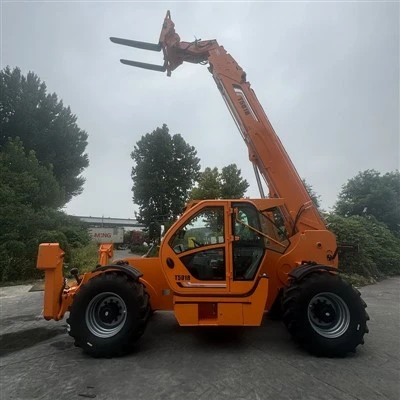
To prevent materials from slipping during forklift operations, three aspects need to be addressed: material securing, equipment adjustment, and standardized operation. Enhancing material gripping stability is crucial to prevent slippage and accidents. Regarding material securing, when handling loose or easily slippery materials, pallets, cable ties, and anti-slip mats should be used. Materials should be neatly stacked on pallets and securely tied with cable ties, or anti-slip mats should be placed on the forks to increase friction. When handling irregular materials, specialized attachments (such as clamps or side shifters) should be used to directly grip the material and prevent slippage.
Regarding equipment adjustment, the fork spacing should be adjusted according to the weight and size of the material to ensure symmetrical support of the material's center of gravity. The forks should be inserted deep enough, at least two-thirds of the material's length, to avoid uneven loading. The fork tilt angle should be adjusted; during handling, the forks should be slightly tilted back, and the angle should be adjusted slowly during stacking and unloading to prevent material swaying and slippage. The fork surface should be checked for smoothness; if severely worn, it should be polished or replaced to enhance anti-slip properties. Regarding operating procedures, start, turn, and brake smoothly to avoid sudden stops or turns that could cause material to sway; avoid overloading or uneven loading during operation to maintain a stable center of gravity for the material; raise and lower the forks slowly and precisely adjust their position when stacking or unloading to prevent collisions that could cause material to slip.